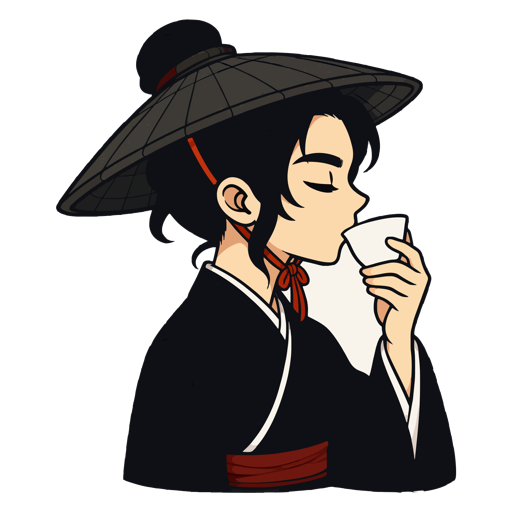
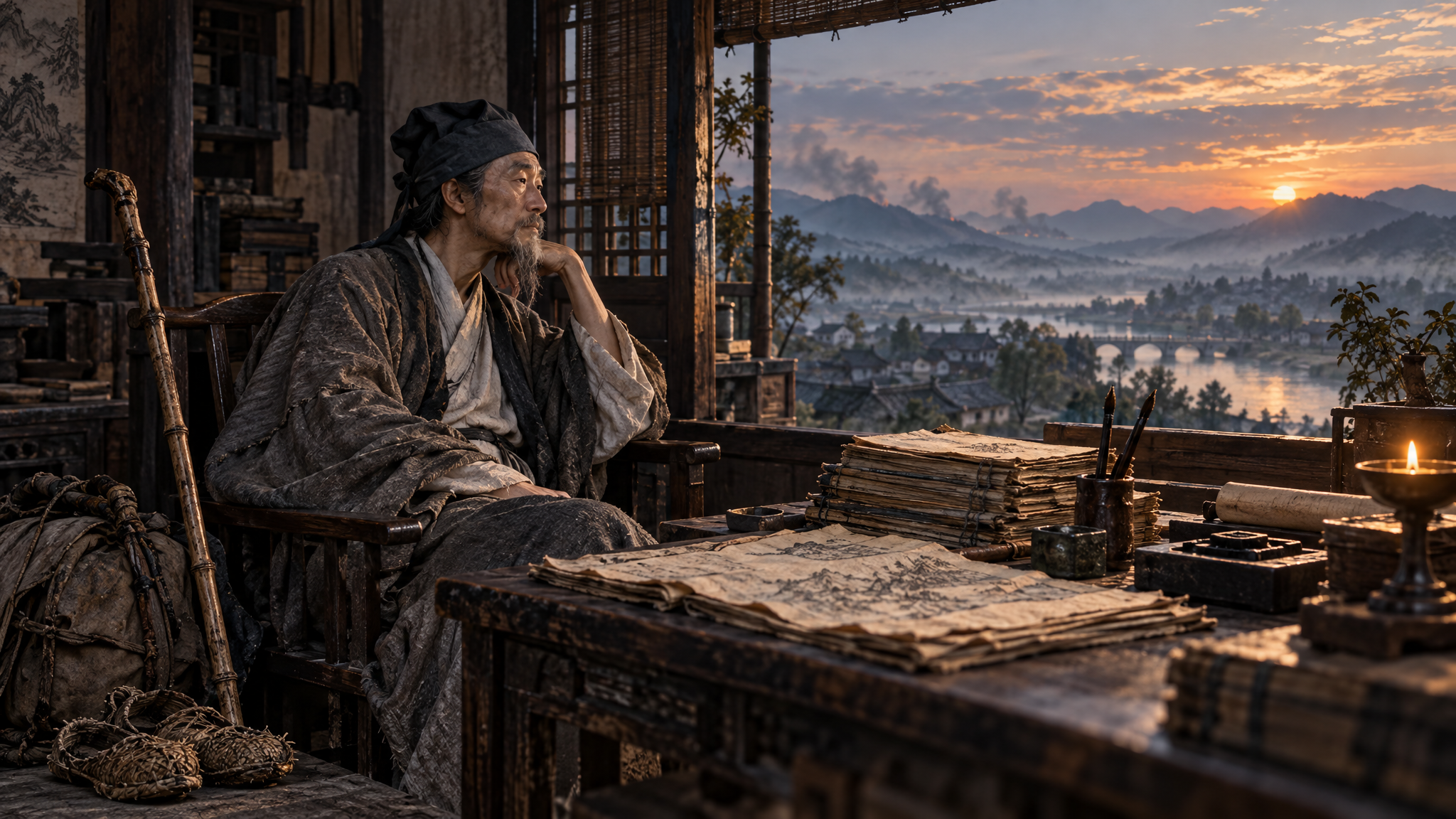
1641 年,徐霞客病逝于江阴。
One possessed the highest power in China but could not stop a dynasty from falling. The other held no office, yet chose what his life would mean.
三年后,李自成攻入北京。崇祯皇帝走上煤山,在一棵树下结束了自己的生命。延续二百七十多年的明王朝,也走到了终点。
Xu Xiake died in Jiangyin in 1641.
一个是统治天下的皇帝,一个是无官无职的布衣。
Three years later, rebel forces led by Li Zicheng entered Beijing. The Chongzhen Emperor climbed Coal Hill behind the imperial palace and ended his life beneath a tree. The Ming dynasty, more than 270 years old, had reached its end.
皇帝用十七年试图挽救一个王朝,最终还是失去了天下;布衣用三十多年行走山河,最终完成了自己。
One man was the emperor of China. The other was a commoner without official rank.
如果结局都无法逃过死亡,什么才算成功的一生?
The emperor spent seventeen years trying to save a dynasty and still lost his realm. The commoner spent more than thirty years walking through mountains and rivers and, by the end, had completed the life he chose.
If every life ends, what does it mean for a life to succeed?
一个已经多处起火的帝国
An empire already on fire
1627 年,十六岁的朱由检登上皇位,年号崇祯。此时的明朝,早已不是一座稳固的宫殿。
Zhu Youjian took the throne in 1627 and adopted the reign name Chongzhen. He inherited an empire under converging pressures: war with the Later Jin in the northeast, an exhausted treasury, unpaid troops, severe droughts and famines, expanding rebellions, and a government weakened by factional conflict and administrative failure.
辽东战事不断,后金步步进逼;国库空虚,军饷难以为继;北方连续发生旱灾、蝗灾和饥荒,越来越多的灾民被推向流亡与反抗;李自成、张献忠等武装力量不断壮大。朝廷内部又有长期积累的党争、腐败与行政失能。
Chongzhen was not a pleasure-seeking ruler who calmly waited for disaster. The official History of Ming portrays him as personally disciplined and tireless in government. He worked hard, lived comparatively frugally, and genuinely wanted to find officials capable of reversing the crisis.
崇祯并不是一个沉迷享乐、坐等亡国的皇帝。《明史》说他“不迩声色,忧勤惕励,殚心治理”。他勤于政务,生活节俭,渴望找到能够挽救危局的人。
Hard work, however, is not the same as sound judgment. He was suspicious and impatient, repeatedly replaced senior officials, and failed to create stable trust between the throne, civil officials, and military commanders. The harder he tried to force quick results, the more his decisions sometimes deepened the disorder.
但勤奋不等于正确。他多疑、急躁,频繁更换大臣,始终无法建立稳定的信任与决策秩序。面对一场接一场的危机,他越想迅速解决,就越容易苛责臣下、改变部署,甚至把失败归咎于刚刚被委以重任的人。
He had inherited a house already burning in several rooms. He fought the fire desperately, but in his panic he sometimes knocked over the water.
崇祯继承的是一栋已经多处起火的房子。他拼命扑火,却也在慌乱中打翻过水桶。
The Ming collapse cannot be blamed on one emperor, nor explained simply as fate. Fiscal weakness, warfare, drought, famine, social rebellion, institutional failure, and bad decisions amplified one another until the crisis grew beyond any single person’s control.
明朝的覆灭,不能只归咎于一个皇帝,也不能用一句“气数已尽”解释。财政、军事、灾荒、社会矛盾和错误决策彼此放大,最终超过了任何一个人的控制能力。
同一场风暴里的另一个人
Another man inside the same storm
崇祯登基时,徐霞客已经四十岁。他人生前半段的重要旅行大多已经完成。真正与崇祯时代重叠的,是他最后、最远也最艰难的一段路。
Xu Xiake was already forty when Chongzhen became emperor. The true overlap between their stories lies in the last and most difficult phase of Xu’s travels.
1636 年,后金改国号为大清。也是这一年,徐霞客告别江阴,开始西南远征。
In 1636, the Later Jin declared itself the Qing. That same year, Xu left Jiangyin on his final expedition into southwest China.
一个人在北京宫城里处理军报、饥荒与催饷奏章;另一个人在湖南、广西、贵州和云南之间,追问洞穴如何连接、江河从哪里发源、山脉怎样延伸。
In Beijing, one man faced military reports, famine memorials, and demands for money. Across Hunan, Guangxi, Guizhou, and Yunnan, another investigated how caves connected, where rivers began, and how mountain systems extended across the land.
但徐霞客并没有真正躲开乱世。湘江遇盗时,他几乎失去全部行李,静闻也因此负伤而死;在湖南和广西,他多次断粮,只能借钱、换米或向人求助;道路失去秩序,盗匪成为旅行的一部分。
Xu did not escape the disorder of his age. Bandits on the Xiang River took nearly everything he carried and wounded his companion Jingwen, who later died. Xu repeatedly ran out of food and depended on loans, barter, monasteries, local scholars, officials, and strangers. The weakening of public order became part of the road itself.
据陈函辉《徐霞客墓志铭》记载,湘江遇盗后,同行者劝他不要再走,他回答:
According to the epitaph written by his friend Chen Hanfu, others urged Xu to abandon the journey after the robbery. He answered, “I came carrying a spade. Where could my bones not be buried?”
“吾荷一锸来,何处不可埋吾骨耶。” He was not unaware of danger. He saw it and continued. ——我带着一把铁锹而来,哪里不能埋我的骨头?
这不是不知道危险,而是知道危险之后仍然决定继续。
他无力改变天下,却能决定自己
Powerless over the empire, responsible for his own life
徐霞客当然无法挽救明朝。他没有军队,没有官职,也没有资格进入决定帝国命运的朝堂。
Xu Xiake could not save the Ming. He commanded no army, held no office, and had no place in the court where imperial decisions were made.
但他保留着一种崇祯反而很难拥有的自由:他可以决定自己这一生究竟为什么而活。
Yet he retained a freedom that was increasingly difficult for Chongzhen to possess: he could decide what his own life was for.
崇祯出生在皇室。从出生和继位的那一刻起,他的人生便和祖宗留下的王朝绑在一起。他的成功标准早已由身份写好:守住江山,成为中兴之主。只要明朝灭亡,无论他怎样勤奋,历史都会首先记住他是亡国之君。
Born into the imperial family, Chongzhen was bound to the dynasty before he was old enough to choose anything. His standard of success had already been written: preserve the ancestral realm and become the ruler who restored it. Once the Ming fell, history would remember him first as its last emperor, however hard he had worked.
徐霞客没有这样的权力,也没有这样的责任。他曾经面对另一套由社会写好的答案:读书,科举,做官,光耀门楣。但他退出了这套标准,为自己重新提出问题。
Xu possessed neither that power nor that burden. Society had offered him a different script — master the classics, pass the imperial examinations, enter government, and honor the family. He stepped away from it and formed his own questions.
山有多高?水从哪里来?洞的尽头是什么?一个人能不能用自己的脚,验证书上的世界?
How high is a mountain? Where does a river begin? What lies beyond the visible end of a cave? Can a person test the world described in books with his own feet?
崇祯拥有天下,却越来越无法支配自己的命运。徐霞客没有天下,却在很大程度上拥有了自己的人生。
Chongzhen possessed an empire but gradually lost control over his fate. Xu possessed no empire, but to a remarkable degree he possessed his own life.
为什么说徐霞客更幸运
Why Xu Xiake was the fortunate one
这种幸运,不是因为他的人生轻松。
Fortune did not mean ease. Xu lost parents and friends, met bandits, went hungry, and eventually lost the use of his feet. Nor was he a destitute wanderer sustained by willpower alone. His family retained land, education, and social connections. His mother supported him. Friends, monks, local elites, officials, and the Mu rulers of Lijiang helped him along the way.
他失去父母和朋友,三次遇盗、四次断粮,最后双足病废。他也不是一个毫无条件、只凭意志行走的穷苦孤客。徐家仍有一定田产和教育条件,母亲支持他的选择;旅行途中,朋友、僧人、地方士绅、官员和云南木氏土司都曾帮助过他。
His freedom rested partly on material conditions and partly on other people willing to hold him up.
他的自由有现实基础,也有别人托住他的结果。
His greatest fortune was nevertheless rare: he discovered early what truly mattered to him, and then spent his life doing it.
但他最难得的幸运仍然是:他很早就知道自己真正热爱的是什么,并且真的用一生去做了。
In 1640, illness in Yunnan made him unable to walk. The Mu administration in Lijiang arranged for him to be carried home in a bamboo sedan, a journey that the epitaph says lasted roughly 150 days. Back in Jiangyin, he could no longer travel. He kept unusual stones gathered on the road beside his bed and passed his days touching and looking at them.
1640 年,徐霞客在云南双足病废。丽江木氏安排人用竹轿送他返乡,一路辗转约一百五十日。回到江阴后,他已经无法再出门。据墓志铭记载,他把从远方带回来的奇石放在床前,日日摩挲相对。
The road had ended, but he did not reject the road he had taken.
路不能再走了,但他没有否定走过的路。
After his mother died and the mourning period was over, the epitaph says, he left home “counting neither distance nor years.” He never became an official, received no state commission, and did not change the direction of his age. He did fulfill the standard he had chosen for himself.
他曾说,母亲在世时,身体不能完全许给山水;母亲去世、守丧期满后,他便“不计程,亦不计年”地出发。到生命终点,他没有成为官员,没有得到朝廷授予的使命,更没有改变时代,却完成了自己为自己选择的标准。
That was his good fortune.
这就是他的幸运。
历史划出边界,我们决定如何生活
History sets limits; we decide how to live within them
从宏观历史看,无论皇帝还是布衣,都像长河中的一粒沙。出生决定了起点,时代划出了边界,战争、疾病和偶然又不断改变人的道路。没有谁能完全掌握命运。
From the distance of centuries, emperor and commoner alike can seem like grains of sand in a vast river. Birth sets a starting point. An age establishes boundaries. War, illness, and accident continually redirect the path. No one controls fate completely.
但这不意味着一切早已注定。
That does not mean everything is predetermined.
崇祯不能只把亡国归咎于命运,因为权力越大,责任也越大;徐霞客也不是靠一句“随心所欲”便获得自由,他的道路由选择、条件、帮助和代价共同铺成。
Chongzhen cannot be relieved of responsibility by calling the collapse destiny: the greater the power, the greater the responsibility. Xu did not obtain freedom merely by following his heart; his path was made from choice, material conditions, help from others, and extraordinary cost.
真正属于我们的,也许只是边界之内那一小部分:把时间交给什么,愿意为什么承担代价,在外界的标准之外,如何判断自己这一生有没有白过。
What remains ours may be only a small space within those boundaries: what receives our time, what deserves our sacrifice, and how we judge a life when the world’s standard is not enough.
我们不必把全部生命耗在自己无法控制的洪流中。认清边界,珍惜拥有的条件,然后把有限的时间交给真正重要的事情。能够找到热爱,又认真坚持下去,已经称得上成功的一生。
We do not have to spend our entire lives fighting currents we cannot control. We can understand our limits, value the conditions and people that support us, and devote our finite time to what truly matters. To find something worth loving and remain faithful to it is already one form of a successful life.
崇祯没能守住他的天下。
Chongzhen could not preserve his empire.
徐霞客却找到了自己的山河。
Xu Xiake found his own landscape.
写在最后
A personal note
我最初认识徐霞客,也要感谢当年明月和他的《明朝那些事儿》。是这套书让我第一次感到,历史不只是帝王、战争和朝代更替,也是一个个具体的人,如何在自己的处境中作出选择。
I first came to know Xu Xiake through Those Ming Dynasty Stories (Ming Chao Na Xie Shi Er) by the popular writer Dangnian Mingyue. The series taught me that history is not only a record of emperors, wars, and dynastic change. It is also the story of particular people making choices inside circumstances they did not create.
《明朝那些事儿》是一部面向大众的历史叙事,不是学术专著,却是一扇很好的入口。如果你能够阅读中文,又对中国历史感兴趣,不妨从这里开始。明朝是中国历史上最有创造力、最富戏剧性、也最充满矛盾的朝代之一。
The books are popular narrative history rather than academic scholarship, but they are an engaging doorway into the period. If you read Chinese and are curious about Chinese history, they are worth trying. The Ming was one of the most creative, dramatic, and deeply contradictory periods in China’s past.
下一篇,我们回到徐霞客身后。他去世时,《徐霞客游记》还不是一本正式出版的书。战火很快烧到江阴,那些记录山河的纸页,也差点和王朝一起消失。
Next, we turn to what Xu left behind. When he died, the Travel Diaries of Xu Xiake was not yet a formally published book. War soon reached Jiangyin, and the pages on which he had preserved the landscape nearly disappeared with the dynasty.