
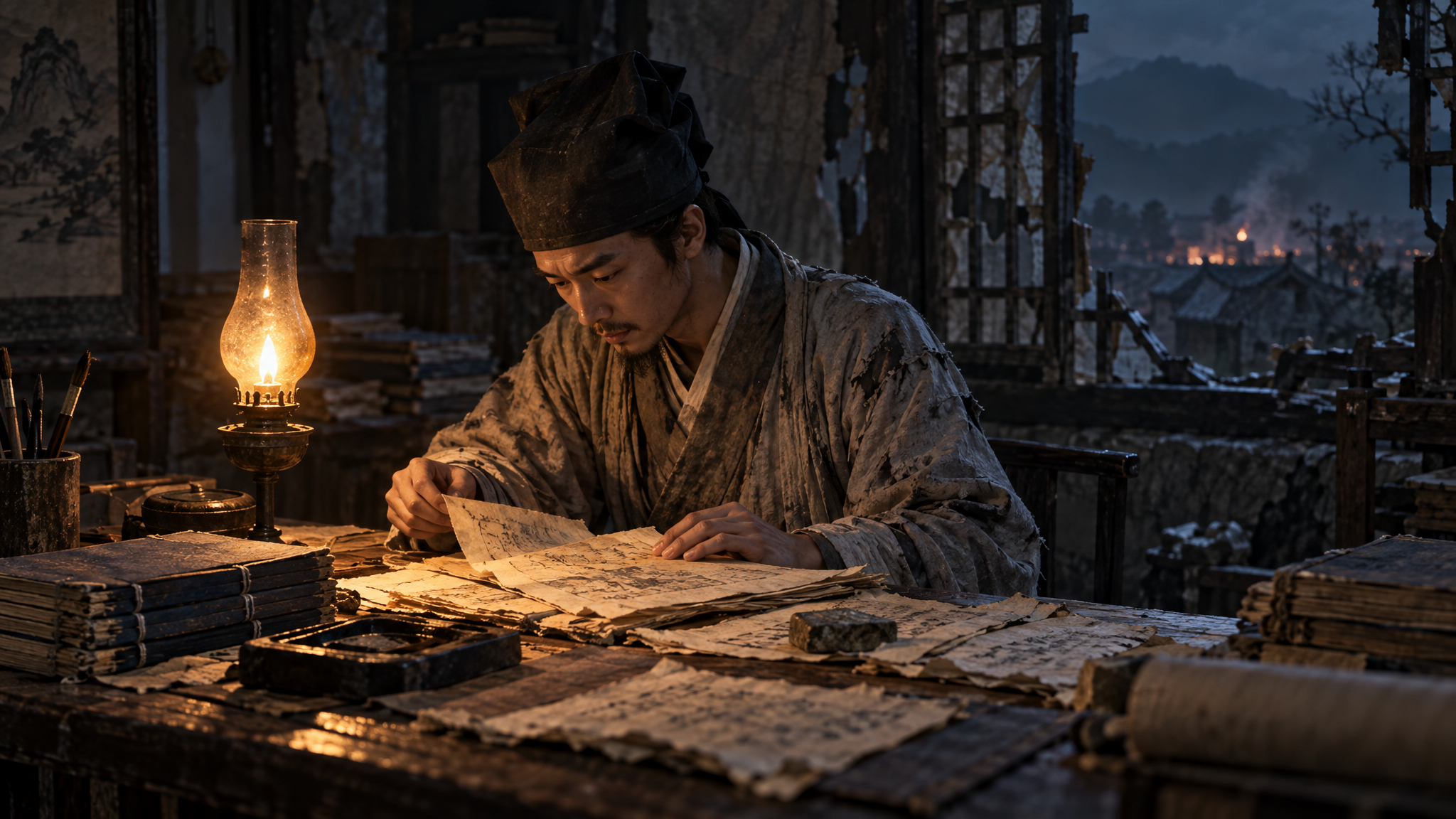
——四百年,多少人替它活了下来
Its author died, war scattered the manuscript, and generations of readers fought to put it back together.
徐霞客去世时,《徐霞客游记》还没来得及整理成册。
When Xu Xiake died, the Travel Diaries of Xu Xiake was not yet a book in the modern sense. There was no standard table of contents, no stable version, no publisher, and no copyright page. It was a mass of diaries, notes, and fragments written over decades and kept in private hands.
没有统一目录,没有稳定版本,没有出版社和版权页。它还只是几十年间写下的日记、札记和片段,散在家中,由亲友分别保管。作者离世之后,这些珍贵文字的命运也随之蒙上阴影。
The author’s life had ended. The text was close to ending too.
从私人手稿到“季本”
徐霞客去世后,据相关整理记载,季梦良受托开始整理遗稿。后世通常把这一早期整理系统称为“季本”。他把零散文稿抄录、编次,尽力整理成册,这才第一次改变了这些文字的命运。但“整理”不等于“完成”。不同日记之间有缺页、重复和时间空隙,有些篇章只剩残卷。季梦良所做的,更像是在一座倒塌的房子里抢救还能辨认的梁柱。
After Xu’s death, historical accounts say that Ji Mengliang was entrusted with organizing the papers. Later scholarship usually refers to this early editorial system as the “Ji edition.” Ji transcribed and arranged scattered drafts, trying to form a coherent volume for the first time.
1645 年,江阴之变
明清易代的暴风很快吹到江阴。1645 年,江阴军民抗清,守城八十一日;城破之后发生大规模兵祸。据相关记载,徐家遭遇家难,长子徐屺遇难,家宅和书稿也在焚毁、抢掠与逃散中受损。
This was a fragile kind of publishing. In late imperial China, a text could circulate as a family manuscript, a hand-copied notebook, or a version kept by a collector. Each copy might preserve a different page, while none could guarantee that the whole work would survive.
初步整理的游记,几乎再次归于虚无。
But arranging a manuscript is not the same as completing it. Pages were missing. Dates did not always line up. Some sections survived only as fragments. Ji was working less like a publisher than like someone salvaging beams from a collapsed house.
这不是文学化的夸张。古籍保存从来不是“作者写完,后人自然就能读到”这么顺利。纸会烧掉,家会被毁,抄本会被带走,一个人的记忆也会在饥荒和战争里中断。一部书能留下,往往依靠许多没有署名的人,在最混乱的时候把纸页藏起来、重新抄录、彼此校对,再一代代传下去。
The collapse of the Ming brought a new disaster. In 1645, Jiangyin resisted the Qing for eighty-one days. When the city fell, large-scale violence followed. According to related historical accounts, the Xu family suffered a catastrophe; Xu Xiake’s eldest son, Xu Qi, was killed, and the family home and manuscripts were damaged or scattered in fire and looting.
一个不能姓徐的儿子
徐霞客的幼子李寄,是这条传承链上最令人心酸的人物之一。因家庭变故,他随母亲改姓李,不能继承父亲的姓氏,一生清贫,以布衣终老。
The newly organized travel text nearly disappeared again.
但他没有放下父亲的文字。他长期搜访遗稿和抄本,向藏书家借阅,逐篇抄录、比对,把散在不同人手里的残片一点点拼接起来。西南游记等重要内容,正是在这类持续的搜访和补辑中得到保存。
The danger was not only that a few pages might be lost. Once a household archive was broken apart, later readers might not even know which fragments belonged together. Reconstructing a book meant recovering its physical pages and its identity at the same time.
需要谨慎的是,不能把李寄写成独自完整恢复全部游记的人。更准确的说法是:在稿本散佚之后,他是最重要的搜访、补辑和保存者之一。
Ancient books do not survive automatically because an author has finished writing. Paper burns. Houses are destroyed. Copies are carried away. Memory breaks under war and hunger. A text often survives because unnamed people hide pages, copy them again, compare different versions, and pass them on.
他无法继承父亲的姓,却继承了父亲最重要的遗产:对真实山河的忠诚,以及把所见所思留下来的责任。
Xu’s youngest son, Li Ji, is the most poignant figure in this chain. Because of family circumstances, he took his mother’s surname. He could not inherit the name Xu, lived in poverty, and died as a commoner.
还需要“识货的人”
书稿要活下来,光有家人还不够,还需要有人看出它的价值。
He did inherit his father’s most important responsibility. Li spent years searching for manuscripts and copies, borrowing from collectors, transcribing entries, and comparing versions. Important sections, including parts of the southwest travels, were preserved through this patient process of searching and supplementation.
明末清初的钱谦益读到徐霞客遗稿后,称他为“千古奇人”,称《徐霞客游记》为“千古奇书”,并写信推动徐氏后人和出版者刊刻。钱谦益的作用,不只是赞美,而是把私人家藏引入公共文化的视野。
The history should be stated carefully. Li Ji did not single-handedly restore the entire Travel Diaries. More precisely, after the manuscript had been dispersed, he was one of its most important searchers, editors, and preservers.
然而,被看见不等于马上出版。战乱、资金、抄本差异和整理难度,都让刊刻一再推迟。徐霞客去世一百多年后,乾隆四十一年,也就是 1776 年,徐镇等后人汇集相关抄本并刊刻。通常认为,徐镇刻本是《徐霞客游记》的第一个正式刻本。
He could not inherit his father’s surname. He inherited his father’s loyalty to the real landscape, and the responsibility to preserve what had been seen and thought.
从 1641 到 1776,中间是一百三十多年的等待。一本书活得比作者久,不是因为纸张有魔力,而是因为一代代人被其中的精神打动,愿意默默承担整理、保存和传递的责任。
Family effort alone was not enough. A manuscript also needed readers who recognized its value. The late-Ming and early-Qing scholar Qian Qianyi called Xu a “rare man through the ages” and the Travel Diaries a “rare book through the ages.” He wrote to encourage Xu’s descendants and potential publishers to print it.
丁文江:重新发现一个科学旅行者
进入二十世纪,地质学家丁文江重新校订、研究《徐霞客游记》,并编写《徐霞客年谱》。他做的不只是把错字改正,还把游记放回地图、地质学和历史地理学的脉络中。
Recognition did not produce immediate publication. War, money, differences among copies, and the sheer difficulty of editing all delayed the project. More than a century after Xu’s death, in 1776 during the Qianlong reign, Xu Zhen and other descendants gathered relevant manuscripts and had an edition carved and printed. It is commonly regarded as the first formal printed edition of the Travel Diaries.
在丁文江以及后来研究者的努力下,徐霞客不再只是一个“爱旅游的古人”,而被重新认识为地理学先驱、地貌考察者、科学旅行者和文学家。后人不是把他简单捧上神坛,而是通过校勘、定位和复测,说明他的哪些观察可靠,哪些判断受时代知识限制。
From 1641 to 1776 is more than 130 years. A book lived longer than its author because generations were moved by what it contained and willing to perform slow, exacting work without knowing whether anyone would thank them.
后人从他走到哪里
传承不是重复原文,而是在前人的方向上继续走。
In the twentieth century, the geologist Ding Wenjiang re-edited and studied the Travel Diaries and compiled a chronology of Xu’s life. Ding did not merely correct characters. He placed the text back into maps, geology, and historical geography.
徐霞客论证金沙江是长江主干源流,二十世纪的科学考察继续向上游推进,将现代意义上的源头追溯到唐古拉山地区的沱沱河。他没有被“推翻”;后人把他走到金沙江的方向再向前推进。
Through Ding and later scholars, Xu was recognized not simply as an ancient traveler but as a pioneer of geographical fieldwork, an observer of landforms, a scientific traveler, and a writer. This was not a matter of placing him on a pedestal. It involved collation, location, and re-survey: determining which observations remain reliable and which conclusions reflected the limits of seventeenth-century knowledge.
他记录七星岩和许多喀斯特洞穴,现代岩溶地貌学用测绘、化学和地下探测研究同一片土地。今天的复测,让读者可以把他的文字与真实洞道对照。
That distinction matters for readers today. To study Xu is not to pretend that he possessed modern instruments. It is to understand what careful observation looked like before modern geography had become an established profession.
他写过腾冲的火山和温泉,现代地质学继续研究腾冲火山地热系统。早期笔记不是终点,却为后来的科学留下了珍贵的现场坐标。
Inheritance also means continuing in a predecessor’s direction. Xu argued that the Jinsha was the main upper course of the Yangtze. Twentieth-century expeditions went farther upstream and traced the modern source to the Tuotuo River in the Tanggula region. They did not simply refute Xu; they extended the correct direction beyond the point he could reach.
后世也以不同方式纪念他:2011 年 5 月 19 日成为中国旅游日;江阴马镇更名为徐霞客镇;徐霞客故居、晴山堂石刻得到保护;研究者、地方文化项目和今天重走霞客路的旅行者,仍在使用他的名字和路线。
Xu described Seven-Star Cave and many other karst landscapes. Modern geomorphology now studies the same terrain with surveying instruments, chemistry, and underground detection. His notes can be compared with actual passages. He recorded volcanoes and hot springs around Tengchong; modern geology continues to study the region’s volcanic and geothermal system. His observations were not the endpoint, but they preserved valuable field coordinates for later science.
守护,不是把书锁起来
真正的文化传承,不是把一本书锁进玻璃柜,让它安全却无人阅读。它需要整理、校对、解释和使用,也要允许新证据修正旧说。传承下来的不只是文字,还有徐霞客对自然的热爱、对观察的严谨、对承诺的守护和对梦想的执着。当后人重读《徐霞客游记》,跟随他的足迹踏上新的旅程,这些品格也会在新的生命中继续生长。
There is a public, everyday layer of inheritance too. May 19 became China’s Tourism Day in 2011. Jiangyin’s Mazhen was renamed Xu Xiake Town. His former home and the inscriptions of Qing Shan Hall have been protected. Researchers, local cultural projects, and travelers who retrace the Xu Xiake routes continue to put his name to work.
这就是传承:不是替过去说话,而是让过去继续参与今天对世界的提问。
Real preservation is not locking a book in a glass case. It means organizing, checking, explaining, and using it, while allowing new evidence to revise old claims.
What is passed down is more than the text. Xu’s love of nature, rigor in observation, loyalty to promises, and persistence in pursuing a dream have traveled with the words. When later readers reopen the Travel Diaries and follow his routes on new journeys, those qualities can take root in new lives.
That is inheritance: not speaking for the past, but allowing the past to keep asking the present how the world really is.